
2
Assumptions and Modelling
2.1
Context and objectives of the scenario development for Med-TSO
The scenario-building process implemented by Med-TSO is conceived as the foundation for assessing future energy requirements. It is designed to provide a quantitative basis for infrastructure assessment and network planning, thereby establishing a set of plausible futures against which system performance can be evaluated. In practice, scenarios are crafted to capture the dynamic uncertainties of the energy transition.
The Med-TSO framework includes three scenarios: Inertial, Proactive, and Mediterranean Ambition, which reflect potential long-term interactions among national power systems, ultimately leading to a coordinated Mediterranean Power System. These 2040 scenarios outline pathways from the present to diverse possible future trends in energy demand, electricity generation, sector coupling, technology evolution, policies, and decarbonisation targets, providing a robust foundation for grid development studies. In the long term, the uncertainties are inherently multifaceted. For example, structural issues raised by the 2022-2023 energy crisis illustrate the complex relationship between relative energy prices and the extent of electrification in industry, heating, and transportation. There is also uncertainty regarding the pace of development for technologies that could be crucial in the energy transition, such as green hydrogen, but which are not yet mature.
In contrast, the level of uncertainty for the 2030 horizon (less than five years from now) remains relatively limited, leading Med-TSO to develop a single, consolidated projection for the medium-term evolution of Mediterranean electrical systems. This projection aligns with the NT+2030 scenario of the TYNDP2024 for European countries.
Integrated energy system modelling - green hydrogen
Some MENAT countries possess significant renewable resources, both in terms of performance (in certain regions of southern Morocco, Tunisia, or Egypt, the wind capacity factor can exceed 50%, or even 60%), and potentially mobilisable capacity, to play a significant role in the low-carbon hydrogen market (so-called renewable hydrogen, or green hydrogen) and its derivatives.
According to their distance from electrical grid infrastructures and the destination of the produced hydrogen, areas suitable for renewable hydrogen development can be connected to the electrical grid (on-grid configuration), operate in an isolated configuration (off-grid), or in a hybrid configuration.
In an export perspective mainly oriented towards Europe, the assumptions and modelling of renewable hydrogen production and its derivatives in MENAT countries have been constructed in alignment with the EU Delegated Act 1087 of February 10, 2023, which establishes a methodology setting out detailed rules for the certification of renewable liquid and gaseous transport fuels of non-biological origin (RFNBO). The Act outlines the requirements for the production of renewable hydrogen that apply to both domestic producers and producers from third countries that wish to export renewable hydrogen to the EU for it to count towards EU renewable energy targets. Specifically, this includes the potential implementation of additionality criteria indicating that the renewable energy source plants are being built in addition to other RES plants, i.e., specifically to convert primary energy into RFNBO.
It is also essential to consider the entire industrial dimension of P2G installations, especially regarding their behaviour on the electricity market as operators seek to maximise their operational profit. Notably, the Delegated Act does not prohibit electrolysis installations (also called Power-to-Gas, or P2G) from participating in the Balancing Market, particularly through upward and downward offers, similar to demand-side reserve actors. Without calling into question the compliance criteria of the Delegated Act, P2G business models must fully consider the economic viability of this industry. This includes leveraging all the opportunities that the electricity market offers for the valorisation of the flexibility that P2G installations can propose. In this context, the modelling approach adopted by Med-TSO to model the behaviour of P2G operators in the power system follows the scheme presented below (Graph 1).
For each country, the model structure may include three nodes:
• A general node, referred to here as ‘node XX00’, which represents the power market area and includes electrical interconnections with other countries. This node encompasses all electrical consumption and electricity production capacities not dedicated to hydrogen.
• An on-grid green hydrogen node, noted as ‘node XXH2,’ to which all or part of the renewable production dedicated to renewable hydrogen and the corresponding electrolysers (P2G units) are connected. This node is physically and functionally connected to the general node.
• An off-grid green hydrogen node, where renewable production and electrolysers are not connected to the general grid.
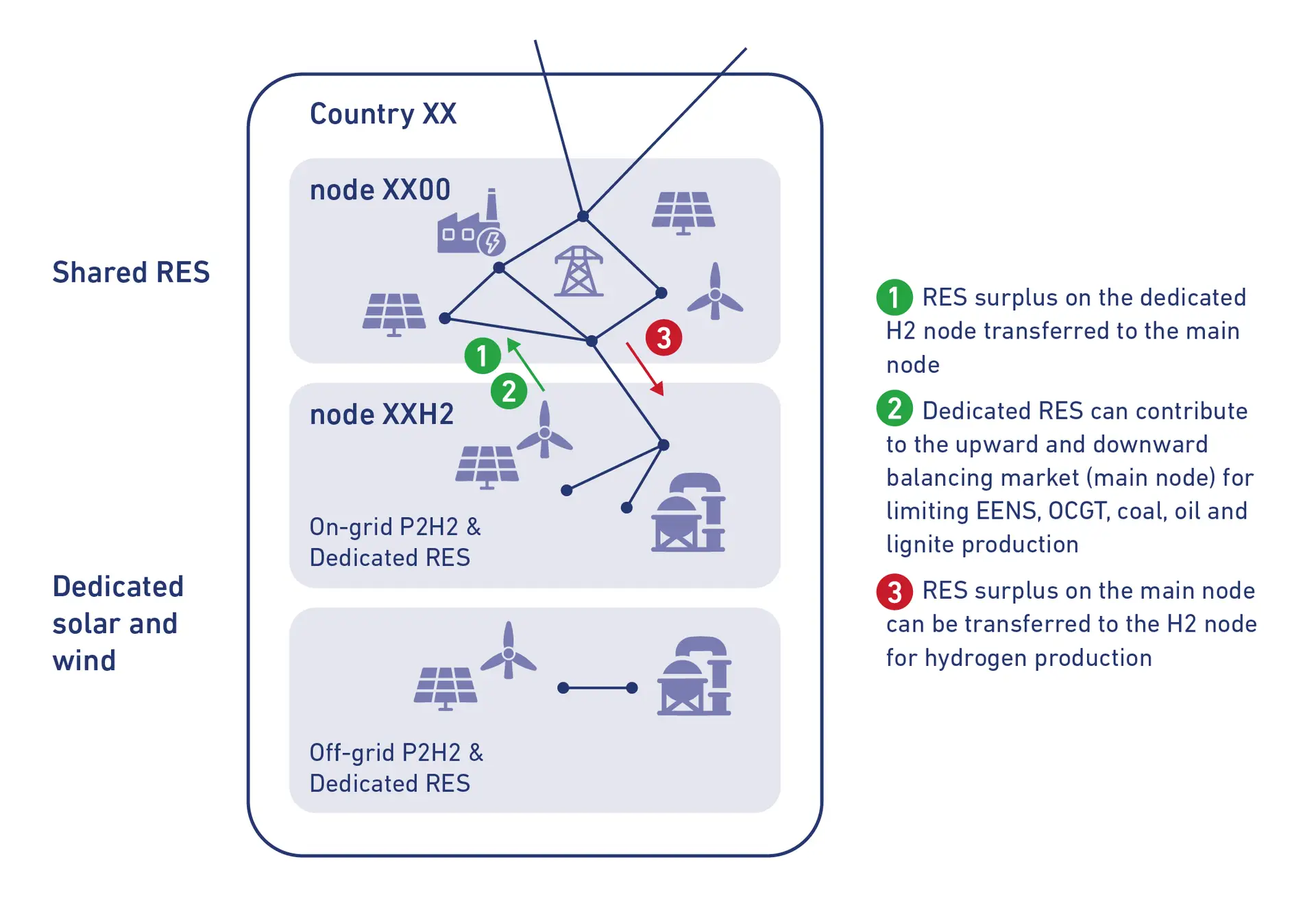
This operational scheme and its associated assumptions are built to adhere to two essential principles:
- The full application of the additionality and temporal correlation principles to ensure Green H2 market integrity.
- The economic viability of P2G business model (including a sustainable capacity factor for electrolysers, and contribution to power system services).
In practice, this modelling results in renewable production and P2G unit behaviour that exhibit the following characteristics:
- The dedicated wind and solar capacity is primarily used for hydrogen production, even when fossil generation is running in the same bidding zone.
- The volume of renewable hydrogen produced never exceeds the dedicated renewable power generation (plus the surplus of RES generation connected on the main node), within any given time interval of the model (typically based on an hourly granularity, consistent with market mechanisms and metering devices).
- The P2G operators can contribute to the power system balancing market. Where physically possible, dedicated RES capacity can:
- Replace high CO₂-emitting generation: OCGT, coal, oil and lignite, based on price-signal.
- Inject RES surpluses into the power market.
- Contribute to preventing load shedding.
Electric vehicle charging modelling
The development of electric mobility is a crucial component in the strategy of many Mediterranean countries aiming to decarbonise the transport sector. It offers a pathway to reduce greenhouse gas emissions, improve energy efficiency, support renewable energy integration, and achieve climate goals while providing economic and public health benefits, in a context of steadily rising mobility demand in most MENAT countries.
In the absence of systemic changes in customer behaviour and charging infrastructure, most EV charging would occur at home, with domestic charging points typically low–power, at 3.5 kW (Level 1) to minimise the tariff and the installation cost. Considering typical users’ driving behaviours, EVs would be commonly plugged in during evening hours. This may significantly contribute to increasing the evening peak demand, generating a fast ramp-up of EV electricity demand, which comes on top of the already existing critical evening ramp of the residual load. Unmanaged charging may exacerbate peak demand, requiring costly peak generation to intervene, trigger extra grid reinforcements, and exacerbate potential adequacy issues.
In response to these identified risks, several smart charging strategies are being employed to shift the charging profile for off-peak times to take on more of the load:
- Offering managed charging to shift home-charging times to non-peak hours, in particular through the implementation of Time-of-Use (ToU) tariff (based on residual load profile, ToU can be especially useful in Mediterranean countries with a high share of PV generation). This charging strategy may be combined with PV self-consumption: charging makes the best use of electricity generated locally by PV panels.
- Balanced charging strategy: The charging power is minimised according to the energy needs and the expected parking time at a certain location. This local optimisation only requires information from the EV and does not consider the state of the grid.
- Promotion of workplace charging to encourage more “middle-of-the-day” charging.
Some charging strategies are dedicated to heavy-duty EV, lorries, buses, vans and minibuses.
- Depot overnight charging is expected to cover about 80% of the total energy demand for HDEV.
- En-route charging along motorways will be necessary for concluding routes in long-haul applications.
- Converting public transportation fleets to EVs should be relatively easy, requiring high-power chargers in garages and depots where buses are parked overnight.
In terms of modelling, two main parameters are associated with the various strategies outlined above to determine the load profiles: the share of charging away from home, and extent of Time-of-Use tariff for EV adoption for charging. Graph 2 illustrates (with realistic but purely illustrative numbers), the impact of these parameters for an electric vehicle fleet consisting of one million cars and 20,000 small trucks and minibuses, based on the two most contrasting strategies:
Strategy A
Limited use (20%) of charging away from home – large majority (80%) of unmanaged charging strategy.
Strategy B
Significant use (40%) of charging away from home – high-level application (50%) of Time-of-Use tariff for EV charging.

Graph 2: Illustration of daily EV charging profile n MENAT countries
The implementation of highly proactive measures to control EV charging profiles can have a significant impact. Strategy B, which combines actions promoting away-from-home charging and Time-of-Use (ToU) pricing with tariff incentives to consume during periods of lowest residual consumption (typically midday to align with peak solar production), can reduce evening peak load demand by half compared to an unmanaged scenario. The coordinated implementation of such measures appears to be an appropriate response to the mass development of electric mobility in Mediterranean countries, preventing uncontrolled growth in evening peak demand in a context where solar will play a significant role in electricity production. Without such strategies, it would be necessary to resort to more costly solutions (batteries, gas turbines, additional network reinforcements).
Scenario storylines
These Med-TSO scenarios for 2040 explore possible trajectories for future load and generation, interacting with the Euro-Mediterranean power system. The scenarios aim to build the path from the present to several possible future trends in load and generation to offer a robust framework for grid development studies
INERTIAL SCENARIO
No breakthrough in the midterm
Under a scenario of moderate GDP and electricity consumption growth – factors that influence electricity demand more significantly in MENAT countries than in European countries – the Inertial scenario implies the achievement of mid-term energy targets aligned with RePowerEU and Fit-for-55 objectives for Europe. However, international cooperation remains limited beyond the European context.
In the Inertial scenario (IN), energy policies primarily prioritise local and national implementation, largely due to persistent disparities in power sector regulations among Mediterranean regions and countries. The advancement of renewable energy sources is steadily but moderately progressing, aligning with national energy policies. Within this context, the development of green hydrogen exhibits only marginal progress, primarily due to the absence of robust regionally coordinated policies and integration. There is no distinct preference either towards small-scale, decentralised plants or large, centralised ones. Overall, progress in the adoption of electric vehicles and electrification in other sectors, as well as energy efficiency measures, remains sluggish, except for a select few countries that have implemented strong incentive policies.
PROACTIVE SCENARIO
Bottom-up boost of distributed generation and electrical devices at the consumer level
With a significant increase in GDP and electricity consumption, there is a stronger commitment to achieving a more sustainable energy sector, leading to an intensified development of renewable energy sources in support of EU climate neutrality by 2050. However, international cooperation among MENAT countries remains limited and robust energy policy integration is still lacking.
In the Proactive scenario (PR), the development of RES is primarily driven by local solutions and tailored regulations or incentives that encourage widespread investments at the consumer and prosumer level. This approach is integrated with smart energy management systems in homes and buildings.
Certain countries are accelerating the integration of green hydrogen strategies, the adoption of electric vehicles, and promoting electrification in other end-use sectors alongside implementing energy efficiency measures. However, significant disparities persist among countries. The implementation of distributed generation reduces reliance on grids and minimises energy losses, although interconnections remain crucial due to the higher penetration of RES.
MEDITERRANEAN AMBITION SCENARIO
Top-down boost for supra-national cooperation and utility-scale developments
With a notable increase in GDP and electricity consumption, there is a heightened aspiration for a more sustainable energy sector, resulting in an intensified development of renewable energy sources (and a stronger commitment to achieving climate neutrality by 2050. Moreover, there is an improved level of cooperation in the Green Transition, encompassing policy integration, financing, industry collaboration, and technology transfer.
This collaborative effort extends across the Mediterranean region, with a multilateral and regional approach that emphasises significant advancements in energy policy integration, regulatory harmonisation, and technical cooperation among grid operators. In the Mediterranean Ambition scenario (MA), the significant growth of renewable energy sources is facilitated mainly through utility-scale projects, supported by institutional agreements and international cooperation, including offtake agreements. The abundance of carbon-free energy sources also fosters the exploration of new applications for electricity, such as green hydrogen, as well as deep electrification of buildings and industrial processes, which are increasingly embraced in national and regional strategies. Additionally, there is a stronger impetus towards energy efficiency. This scenario underscores the complementary nature of diverse countries’ approaches in implementing large-scale projects.
Regarding EU-27 countries, both the Proactive and Mediterranean Ambition scenarios aim to reach full decarbonisation in 2050, with two contrasting pathways proposed in the TYNDP2024 approach: Proactive focuses more on renewable development and decentralised options, while Mediterranean Ambition favours a centralised low-carbon option and more electricity interconnections.
The Mediterranean Ambition scenario stands out from the other two due to one particular driver: enhanced regional cooperation between Mediterranean countries. This MA scenario considers major changes in energy policy integration, regulatory coordination, and technical and financial cooperation.
Among the most essential aspects that this cooperation should encompass, the industrial dimension, for example, could maximise the share of local manufacturing of energy equipment (and thereby boosting employment) in the countries concerned. Access to the most favourable credit conditions is also crucial for supporting investments in renewable energy and related technologies.
Most MENAT countries currently perceive the lack of tangible progress in international cooperation as an obstacle to the full implementation of the policies and investments identified to successfully achieve the energy transition.
Overcoming this obstacle will be crucial to unlocking the full potential of the region’s energy resources and fostering sustainable development. Enhanced collaboration among Mediterranean nations can pave the way for a more integrated energy market, ultimately benefiting all participating countries.
| Drivers | Metrics | Inertial scenario | Proactive scenario | Mediterranean Ambition scenario |
|---|---|---|---|---|
| Macroeconomic trends | GDP/Population growth. | Small growth rate of GDP, continuous but moderate evolution of the economy, resulting in a modest ongoing growth in electricity consumption. | Increase in the GDP growth rate compared to present trends, leading to a higher growth rate of electricity consumption. | |
| Integration of energy policies | Green transition and Paris Agreement, decarbonistion targets achievement. | Green transition deemed to comply with current national objectives (NECP, NDP). Few international cooperations outside Europe. | For MENAT countries, there is still little international cooperation, but increased ambitions in terms of RES development. Evolution to a more sustainable energy sector intensified, despite remaining limitations induced by the weak integration of energy policies and little international cooperation. | For MENAT countries, improved cooperation in the green transition (policy integration, financing, industrial cooperation, technology transfer). MENAT countries committed with the EU in overall energy policies aimed at carbon neutrality by the middle of the century. |
| For EU-27 countries, RePowerEU and/or Fit-for-55 ambition (at least -55% CO₂ emissions reduction in 2030 wrt 1990, 9% reduction final energy demand wrt 2020 Reference scenario, 40% RES share in the overall energy mix), and climate neutrality in 2050. Assumptions and modelling. | ||||
| Regional regulation and/or Mediterranean integration; energy independence. | Energy policies are essentially initiated at a local and national level. Despite political ambitions in EU countries (e.g., RePowerEU plan), Euro-Mediterranean cooperation is struggling to materialise, which negatively affects massive funding needs. Significant persisting contrasts among countries in the power sector regulation. | Enhanced cooperation between the Mediterranean countries at the regional level. Major change in energy policy integration, regulation, coordination, technical and financial cooperation. | ||
| Power supply, RES development | RES development rate. | RES development is moderately strong, corresponding to commitments already made and national energy policies. | RES development benefits from a decentralised approach bringing local solutions that are favourable to investment and integration. | Strong RES development benefiting from international cooperation on large projects backed by institutional agreements. |
| Distributed [vs centralised] technologies. | No strong choice between small distributed and large centralised options. | Focus on distributed energy, initiatives at consumer level and on adapted regulation/incentives. | Focus on large-scale renewable and storage projects and related financing/ business models. Opportunities depend on domestic context for distributed solution and the emerging role of prosumers. |
|
| Electrical mobility. | Modest adoption of EVs with no significant impact on demand. Some exceptions are observed in countries with stronger incentive policies. | In MENAT countries, moderately strong adoption of electric vehicles, whose development remains constrained by vehicle affordability, but also due to reasons of market accessibility and limited local industrial development. Asymmetries are observed between countries, some of which point to a strong adoption rate, leading to a relevant impact on demand. | ||
| Other electrification (heating and cooling inverter and heat-pumps, industrial heating and process electrification). | Modest electrification trend. Exceptions include climatisation technologies in some countries and rare cases of industrial new uses of electricity. | Moderately strong electrification trend. Exceptions include heating and cooling technologies in some countries, and cases of industrial new uses of electricity. | ||
| Electrical efficiency. | Modest adoption of energy efficiency measures, due to the associated investment costs. There are asymmetries across the Mediterranean region. | Moderately strong push towards energy efficiency through technological progress (availability of performing equipment and appliances), and implementation of national policies for energy-efficient behaviour and investment supporting schemes. Asymmetries between countries are relevant, with some showing a greater commitment towards energy efficiency measures. | ||
Table 1: Summary of storyline
Other assumptions
The scenario-building process also includes the determination of common technical parameters:
- The principle of an efficient day-ahead market (or equivalent mechanisms abiding by the same core economic concepts), i.e., where electricity flows from a lower price zone to a higher price zone, independently for each hour of the day.
- The principle of uniform wholesale fossil fuel prices across all Euro-Mediterranean countries. While several countries in the region are, or plan to become, producers and exporters of natural gas, regulated pricing mechanisms may exist for domestic consumption within such countries (generally a low price that benefits the residential consumers or some export-oriented industries). These could be qualified as subsidies; if such subsidised prices were used for economic assessments, it would introduce distortions compared to optimal market-based solutions. However, the adopted principle of uniform fuel prices ensures fair competition between thermal power plants, and enables the international electricity exchanges, which result from it, to be driven solely by fuel type and plant efficiency. Accurate economic assessment must reflect the opportunity cost of the fuels, which correspond to international market prices where they exist, as is the case for oil and gas products.
- The principle of assigning an economic value to CO₂ emissions resulting from electricity generation, common to all Mediterranean countries. This ensures the integrity of regional mechanisms for controlling greenhouse gas emissions, even in the absence of shared regulatory frameworks.
| Commodity | Fuel | 2030 | 2040 |
|---|---|---|---|
| Fuel prices €/net GJ | Nuclear | 1.68 | |
| Lignite | 3.1 | ||
| Hard coal | 1.78 | 1.65 | |
| Gas | 6.29 | 5.65 | |
| Light oil | 11.74 | 11.38 | |
| Heavy oil | 9.63 | 9.33 | |
| Oil shale | 1.86 | 2.71 | |
| Biofuels | Biomethane | 18.8 | 18.04 |
| Synthetic methane | 27.55 | 24.99 | |
| Share in MENAT countries | 0% | ||
| Hyrogen | €/Kg in MENAT countries | 1.88 | 2.05 |
| CO2 | € per ton CO2 | 113.4 | 147 |
Table 2: Commodity prices
Commodity prices
Table 2 presents the fuel and commodity prices adopted by Med-TSO for calculating the variable generation costs to be used for modelling the Euro-Mediterranean power system.
How Med-TSO scenarios are linked to other available scenarios.
The scope of power system modelling includes the whole interconnected power system, which encompasses both European and Mediterranean (extra-EU) countries. For the resulting Euro-Mediterranean power system, a key issue lies in ensuring data consistency among TSOs that are members of ENTSO-E, the association of European TSOs, and Med-TSO.
To facilitate such consistency, the two associations have signed a dedicated cooperation agreement and have established a fruitful exchange of methodologies, models, and data.
Globally, the scenario-building methodology used by Med-TSO is broadly aligned with that of ENTSO-E, particularly for the scenarios proposed for the Ten-Year Network Development Plan (TYNDP) 2024. The principle is to examine the extent to which these drivers coincide, and to proceed with scenario coupling by favouring maximum coherence in the underlying drivers.
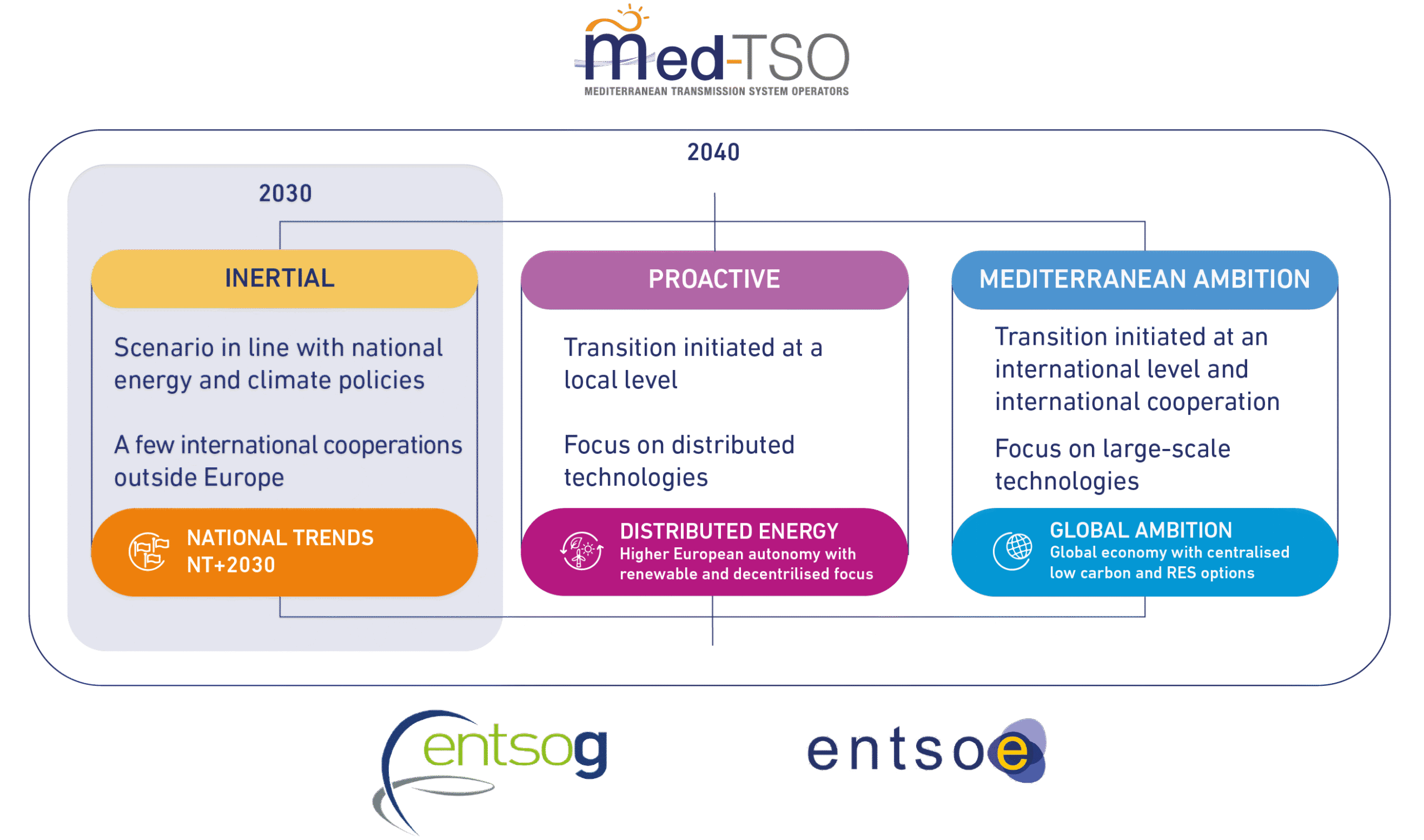
Following a driver-based approach, Med-TSO scenarios are matched with the most similar ENTSO-E scenarios for European countries, as shown below.
Both Med-TSO Inertial and TYNDP2024 National trend (NT+) scenarios share a focus on the achievement of already decided actions and decisions related to energy and environmental policies (Fit-for-55 and RePowerEU for EU-27 members, and pre-approved energy policies and action plans for other countries).
Although Med-TSO and ENTSO-E scenarios are conceptually aligned as summarised above, some discrepancies may arise due to contrasting regulation frameworks. Similar inconsistencies might also exist between Med-TSO’s scenarios and those developed by TSOs at the national level.