
Electricity Generation
and CO2 Emission Perspectivies
4
Electricity Generation and CO2 Emission Perspectives
Generation and renewable share
In the context of a significant increase in the installed capacity of renewable energy, the graph below illustrates the projected evolution of electricity production in the Mediterranean region up to 2040 under the different scenarios. This increase is driven by the need to meet both the growing electricity consumption and the specific demand for green hydrogen production.
Electricity generation in the Mediterranean Countries
(in 2030 & TEASIMED2 scenarios)
Graph 12: Electricity generation in the Mediterranean countries
Overall, electricity production in the region is projected to grow by 30% in 2030 compared to the baseline year of 2023, and by 70% to 110% in 2040, depending on the scenario considered.
By 2030, and even more so by 2040, the most polluting and CO₂-emitting thermal power plants (coal, lignite, and fuel oil) would occupy a minimal role in the Mediterranean electricity mix, accounting for less than 1% in 2040 across all scenarios, compared to 11% in 2023. The production capacity of gas-fired power plants would also see a reduction, although to a much lesser extent, decreasing from approximately 780 TWh in 2023 to 600 TWh projected in 2040, despite a similar installed capacity.
Unsurprisingly, the growth in electricity production will be entirely met by renewable energy sources for all regions combined.
The following table illustrates the proportion of the total electricity demand in Mediterranean countries (including the electricity demand dedicated to green hydrogen production) which is met by renewable energy sources.
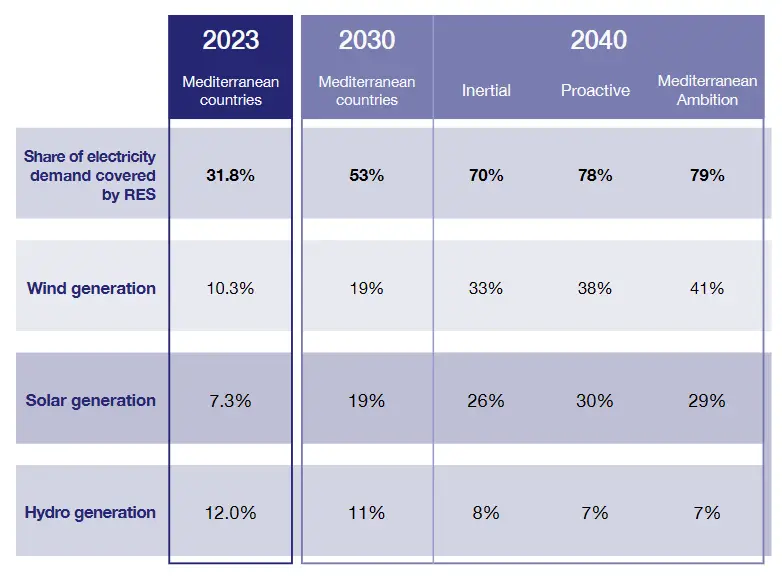
While the share of renewable energy production is about one-third in 2023, it is expected to exceed 50% by 2030 and could account for up to 70% to 80% of the total demand by 2040, depending on the scenarios. Wind energy alone could supply up to 40% of total demand. This represents a major shift in the nature of Mediterranean power systems, which will need to adapt to the widespread integration of these technologies.
It is important to note that the renewable energy production that may potentially be lost due to surplus situations is not subtracted in this table (i.e., renewable production before RES curtailment). The annual energy from renewable sources that could be curtailed is estimated to reach the equivalent of 1% of the total electricity demand by 2030 and between 3% and 4% by 2040.
The figure below indicates the progression of electricity generation across Mediterranean regions
Graph 13: Electricity generation by Mediterranean region
A significant portion of the increase in renewable energy production in the South-West and South-East regions is driven by green hydrogen production, particularly in the Mediterranean Ambition scenario.
Green hydrogen production in North Africa
The figure below indicates the outlook for the green hydrogen production in North Africa, according to the scenario considered.
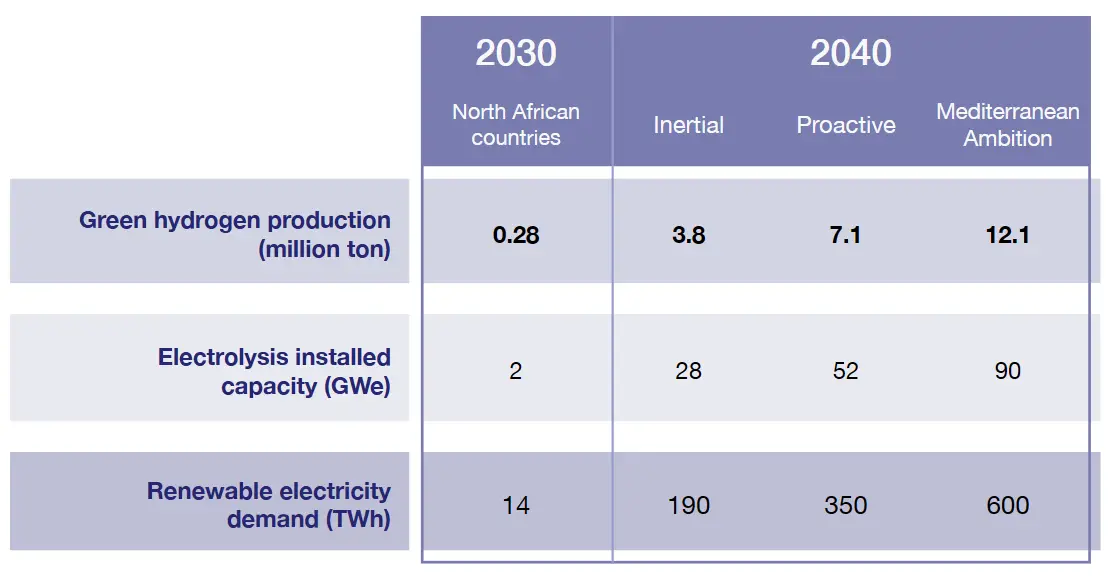
Barely emerging by 2030, green hydrogen production in North Africa could range from 4 to 12 million tonnes by 2040, depending on the scenario considered. In the Mediterranean Ambition scenario, this production would require dedicating 600 TWh of renewable electricity to supply electrolysers.
To illustrate the extent to which the green hydrogen industry could transform the energy sector in North Africa, the following graph compares the electricity consumption for end-uses (including electric mobility) with the electricity demand specifically dedicated to power-to-gas (electrolysis) operations. The graph also indicates the share of this total demand (including electrolysis) that is met by renewable electricity.
Graph 14: Total electricity demand vs RES generation in North Africa
It is quite remarkable to note that renewable production could reach (Proactive scenario) and even far exceed (Mediterranean Ambition scenario) the end-uses of electricity consumption for all North African countries combined. Green hydrogen production constitutes a powerful lever to a major new outlet for the development of renewables in this region. By doing so, it can contribute to global decarbonisation (primarily in Europe) through the export of green hydrogen and its derivatives
CO2 emissions perspectives
While the significant reduction in the use of the most polluting and CO₂-emitting power plants in the Mediterranean region raises hopes for a decrease in CO₂ emissions, the following table provides quantified perspectives for this reduction in the electricity production sector.
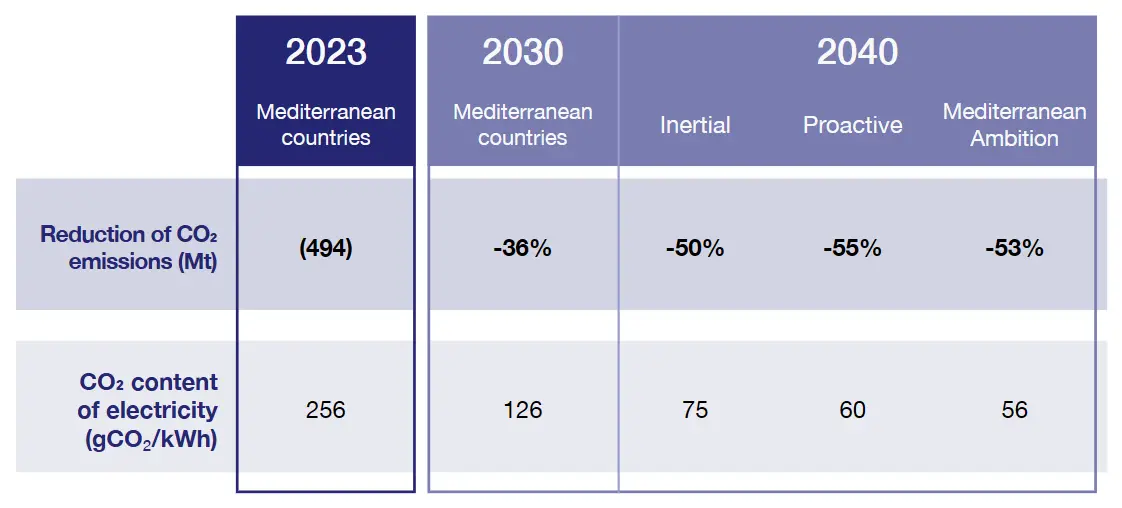
While total Mediterranean electricity demand could increase by nearly 30% by 2030 compared to the reference year 2023, CO₂ emissions from the sector are expected to decrease by 36%. This trend can be explained by two major factors: the significant reduction in the use of coal and lignite power plants (no plants equipped with carbon capture and storage are included in any Mediterranean scenario) and the massive development of renewable energy sources. By 2040, this phenomenon is expected to amplify, with emissions projected to be halved compared to 2023. The CO₂ content of electricity produced in the Mediterranean region, expressed in grams of CO₂ per kWh, is expected to be halved between 2023 and 2030, and halved again in the following decade.
Comparison with previous Med-TSO projections for 2030
This Scenario Report builds upon previous projects conducted by Med-TSO. Although TEASIMED 2 is the first study to focus on the 2040 horizon, it can be insightful to compare the main trends for the 2030 horizon in terms of electricity consumption and the development of renewable energies.
The following table contrasts the perspectives from two previous studies: the Mediterranean Project 2 (MP2) published in 2020, and TEASIMED 1 published in 2022.
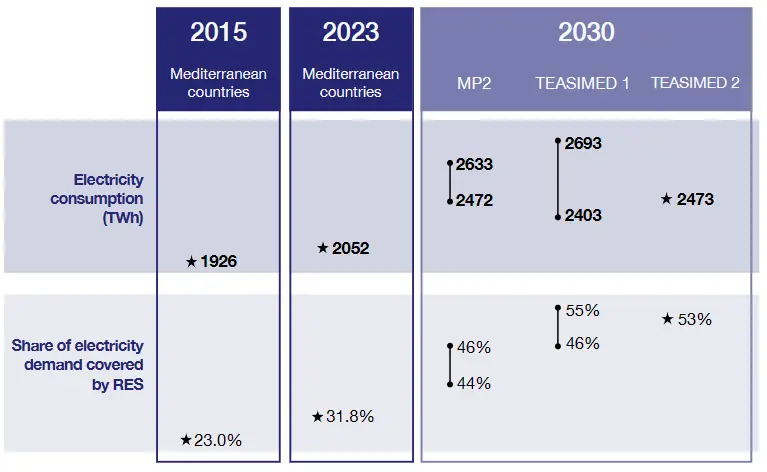
As previously anticipated, the new projection for electricity consumption in 2030 confirms a clear increase compared to 2015-2023. However, it stands at the base of the previous uncertainty margins, reflecting updated socio-economic perspectives. It seems prudent, however, to assume that new updates will adjust these projections to fully integrate the consequences of the most recent crises (e.g., the Russian gas crisis in Europe, the evolving global competition in the industrial sector) and the increasing difficulties toward a wider electrification of the energy sector. The acceleration of RES penetration is confirmed with the new projections for 2030, which stand at the top of the previous uncertainty margins. This reflects both the latest observed trends and the ambitious targets announced by national power systems.